Option Trading
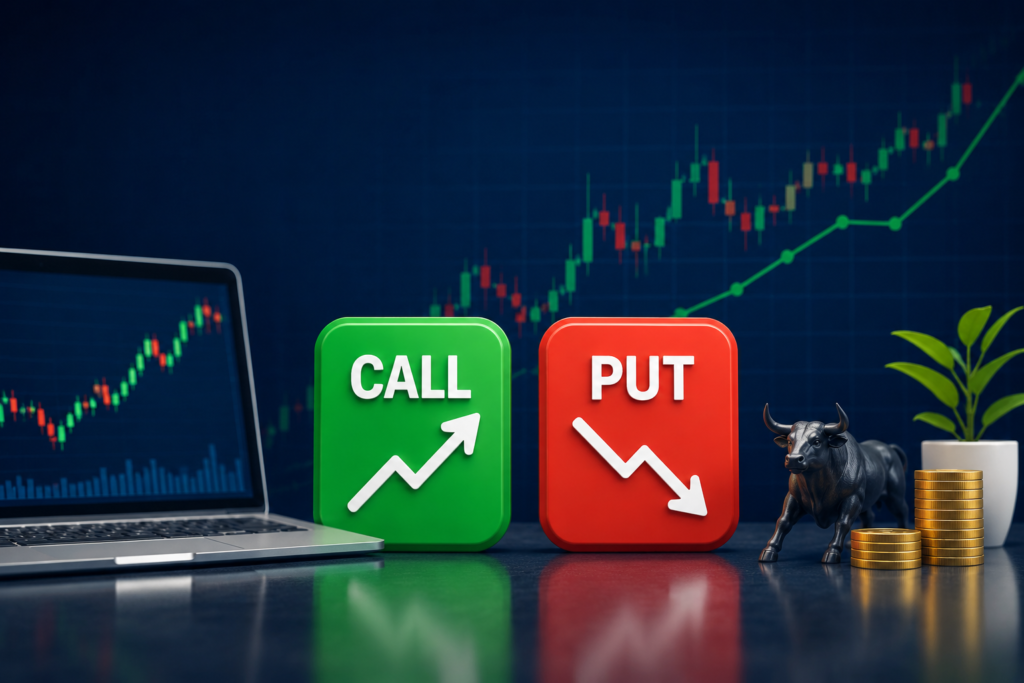
What is Option Trading? Complete Beginner to Advanced Guide (2026) Introduction Option Trading is one of the most popular segments of the stock market because it allows traders to participate in market movements with comparatively lower capital. Options provide flexibility, leverage, and various trading opportunities in both rising and falling markets. Whether you are a beginner or an experienced trader, understanding option trading is essential before risking real money. In this guide, you will learn everything about option trading, including call options, put options, premiums, strike prices, option Greeks, strategies, risks, and real-world examples. What is Option Trading? Option Trading is a financial contract that gives the buyer the right, but not the obligation, to buy or sell an underlying asset at a predetermined price before a specified expiry date. The seller (writer) of the option receives a premium and is obligated to fulfill the contract if the buyer exercises the option. Options are classified as derivatives because their value is derived from an underlying asset such as: Stocks Indices ETFs Commodities Currencies Why is Option Trading Popular? Option trading has gained massive popularity among traders because of: 1. Lower Capital Requirement Instead of buying expensive stocks directly, traders can control larger positions using options. 2. Leverage Options provide leverage, allowing traders to generate higher returns with smaller capital. 3. Hedging Investors use options to protect their portfolios against market downturns. 4. Income Generation Option sellers can generate regular income through premium collection. Key Participants in Option Trading Option Buyer The buyer pays a premium to acquire the right to buy or sell an asset. Option Seller (Writer) The seller receives the premium and accepts the obligation associated with the contract. Understanding Call Options A Call Option gives the buyer the right to purchase an asset at a fixed strike price before expiry. Example Suppose Nifty is trading at 25,000. You buy a 25,100 Call Option for ₹100 premium. Scenario 1: Nifty rises to 25,500. Profit: Intrinsic Value = 25,500 − 25,100 = 400 Net Profit = 400 − 100 = ₹300 per lot unit. Scenario 2: Nifty expires below 25,100. Maximum Loss = Premium Paid = ₹100. Understanding Put Options A Put Option gives the buyer the right to sell an asset at a predetermined strike price. Example Nifty is trading at 25,000. You buy a 24,900 Put Option for ₹80 premium. If Nifty falls to 24,500: Intrinsic Value = 24,900 − 24,500 = 400 Profit = 400 − 80 = ₹320. Important Terminology in Option Trading Strike Price The predetermined price at which the contract can be exercised. Premium The cost paid by the option buyer. Expiry Date The last day on which the option remains valid. Lot Size Minimum quantity that can be traded in options. Open Interest The total number of outstanding option contracts. Implied Volatility (IV) The expected future volatility calculated from option prices. Types of Options 1. Stock Options Options based on individual company stocks. Examples: Reliance HDFC Bank Infosys 2. Index Options Options based on stock indices. Examples: Nifty 50 Bank Nifty FinNifty Sensex Understanding Moneyness In-The-Money (ITM) Call Option: Spot Price > Strike Price Put Option: Spot Price < Strike Price At-The-Money (ATM) Spot Price = Strike Price Out-Of-The-Money (OTM) Call Option: Spot Price < Strike Price Put Option: Spot Price > Strike Price How Option Trading Works Step 1: Select the underlying asset. Step 2: Choose Call or Put. Step 3: Select strike price. Step 4: Choose expiry date. Step 5: Place the order. Step 6: Exit or hold until expiry. Option Greeks Explained Delta Measures how much an option price moves relative to the underlying asset. Gamma Measures the rate of change of Delta. Theta Measures time decay. Vega Measures sensitivity to volatility changes. Rho Measures sensitivity to interest rate changes. Best Option Trading Strategies Long Call Strategy Used when bullish. Long Put Strategy Used when bearish. Covered Call Strategy Used for generating income. Bull Call Spread Used for moderately bullish markets. Bear Put Spread Used for moderately bearish markets. Long Straddle Used when expecting high volatility. Short Straddle Used when expecting low volatility. Iron Condor Popular income-generating strategy. Advantages of Option Trading Limited risk for buyers Leverage Portfolio protection Multiple strategies Income generation opportunities Risks of Option Trading Time decay High volatility Complexity Potential unlimited risk for option sellers Emotional trading Option Trading Example Suppose Bank Nifty trades at 60,000. You expect a rise. You buy a 60,200 Call Option at ₹150. If Bank Nifty moves to 60,700: Intrinsic Value = 500 Profit = 500 − 150 = ₹350. If Bank Nifty remains below 60,200: Maximum loss = ₹150. Option Trading vs Futures Trading Feature Options Futures Obligation No Yes Risk for Buyer Limited Unlimited Premium Required Not Required Flexibility High Moderate Leverage High High Common Mistakes Beginners Make Buying far OTM options Ignoring volatility Overtrading Trading without stop loss Ignoring option Greeks Trading based on tips How to Start Option Trading in India Open a Demat account. Activate F&O segment. Learn basics thoroughly. Practice using virtual trading. Start with one lot. Follow risk management rules. Maintain a trading journal. Frequently Asked Questions Is option trading safe? Option buying has limited risk, but option selling can involve substantial risk. Can beginners do option trading? Yes, but only after understanding concepts and practicing risk management. How much money is required for option trading? It depends on the underlying asset and strategy. Beginners can start with relatively smaller capital through option buying. Which is better: stocks or options? Stocks are generally suitable for long-term investing, while options are often used for short-term trading and hedging. Can I lose all my money in option trading? Yes. Poor risk management can result in significant losses. Conclusion Option Trading is a powerful financial instrument that can help traders profit from both rising and falling markets. However, success requires proper education, risk management, and disciplined execution. Before trading with real money, understand option basics, learn option Greeks, practice strategies, and always follow a structured